we are here to provide deeper insight into the power of art, culture, and community engagement. We create and deliver flexible, creative programs that fit within available resources while maximizing impact.
your success is at the heart of everything we do. We design and deliver flexible, creative programs that align with your needs and available resources.
we provide meaningful insights through creative expression, cultural storytelling, and community engagement. Our approach is flexible and innovative, designed to work within available resources while delivering impactful results.
Our projects are designed to build strong relationships and promote shared values through creative and meaningful engagement. We develop well-crafted programs and content that reflect our commitment to peacebuilding, cultural expression, and Afrocentric literacy.
Our programs are designed to build meaningful relationships and share our core values through well-crafted, engaging content. We focus on delivering impactful initiatives that promote peace, cultural identity, and Afrocentric literacy.
our services are designed to build strong relationships and communicate meaningful values through creative and well-crafted engagement. We provide tailored solutions that support peacebuilding, cultural expression, and Afrocentric literacy.
Rabbi Gbaba’s “Golden Jubilee (50th Anniversary) Address to Liberians and the World: Preserving, Preaching, & Promoting the Culture of Liberia Globally; A 50-Year Journey”
TOP STORIES
Salutations
Your Excellency, George Manneh Weah, outgoing President of Liberia, and Your Excellency
Joseph Nyumah Boikai, President-elect of Liberia, and Vice-President-elect, Jeremiah Kpan
Koung, the President-Pro Tempore and Members of the Liberian Senate, the Speaker and
Honorable Members of the House of Representatives, Your Honor Madam Chief Justice,
Associate Justices, and members of the Judiciary, members of the cabinet, diplomatic corps and
international community, fellow citizens, ladies and gentlemen.
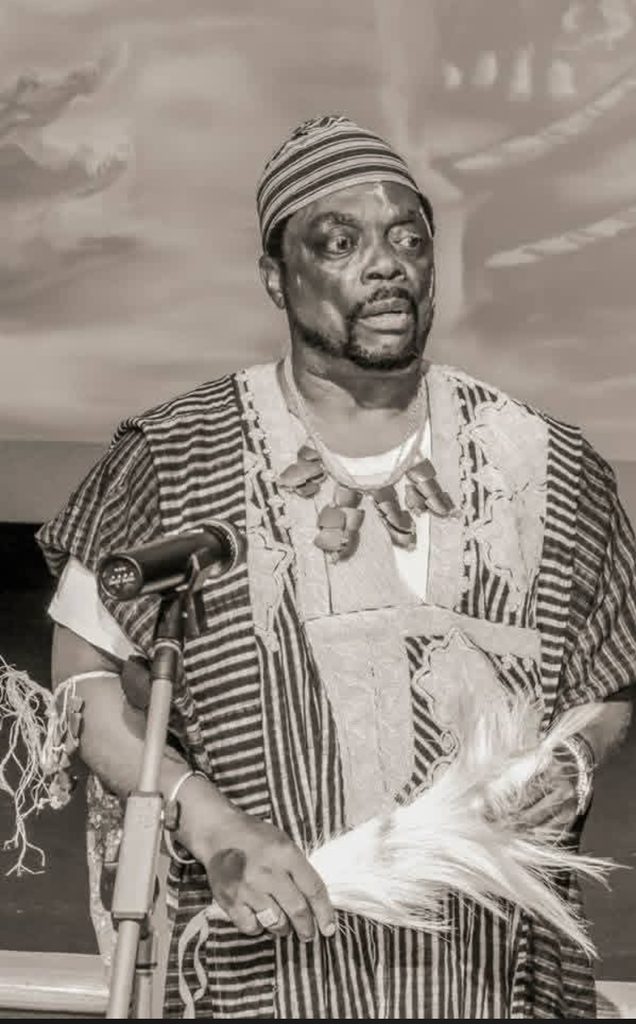
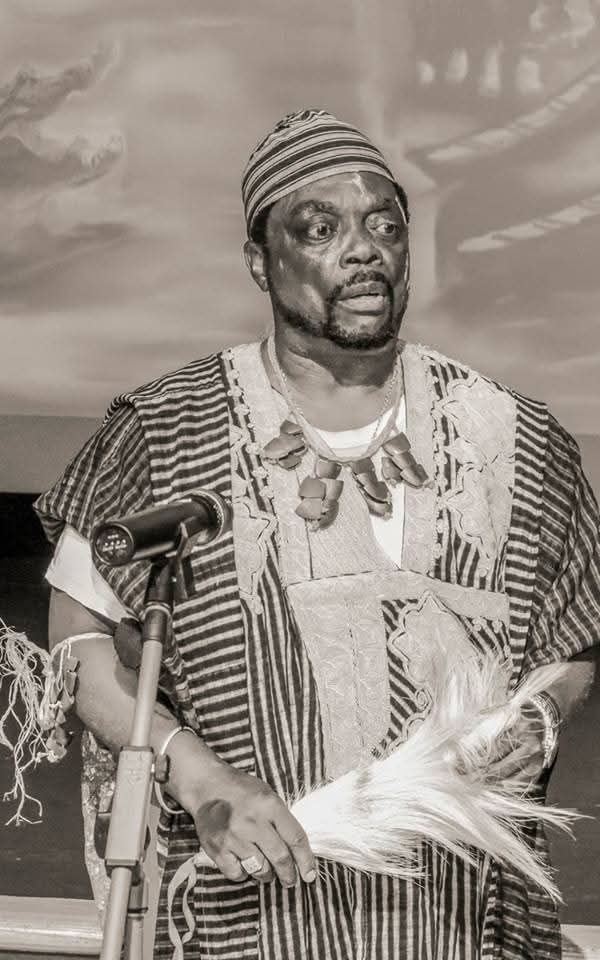
Rabbi Prince Joseph Tomoonh-Garlodeyh Gbaba, Sr., Ed. D. To fully understand the success of our celebrity, one has to research the family he originates from,
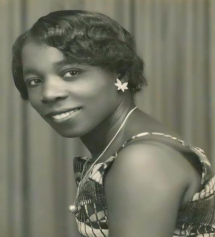
Mrs. Margaret Tiplah-Mona Karpeh-Koffa, Dr. Gbaba’s first school teacher A Winding Road and Uphill Battle to Achieve Education and Success. After the completion of the first grade, Tomoonh-Garlodeyh enrolled at Daniel E. Howard
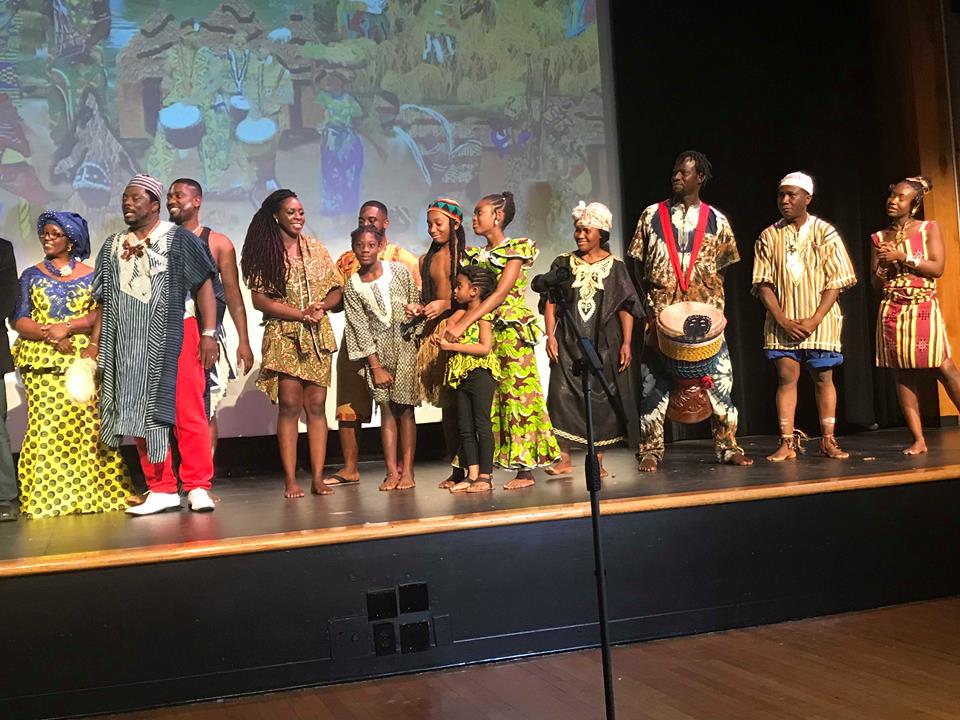
At Dehkontee Artists Theatre, Inc. (DATI), our journey is rich with culture, creativity, and community impact.
At Dehkontee Artists Theatre, Inc. (DATI), we understand that many communities face challenges and changes that affect their cultural expression and education. Through our programs and initiatives, we work to preserve, restore, and empower communities while celebrating their unique heritage.
“We cannot simply copy and paste what took place in Rwanda or South Africa. We must learn from them and adapt what is relevant to Liberia’s unique history and culture”.
MONROVIA, LIBERIA — August 31, 2026: Liberian playwright, educator, cultural advocate and peacebuilding expert Dr. Rabbi Prince Joseph Tomoonh-Garlodeyh Gbaba, Sr., Ed.D., has called on President Joseph Nyuma Boakai, Sr. to ensure that Liberia’s renewed peacebuilding and cultural revival efforts are inclusive, participatory and rooted in Liberia’s own history and traditions.
Dr. Gbaba made the call in a communication to President Boakai following reports that a Liberian delegation is visiting Rwanda and South Africa to study their approaches to peace, reconciliation and cultural preservation. While welcoming the President’s initiative, Dr. Gbaba said Liberia can learn valuable lessons from both countries but should not simply “copy and paste” foreign models into the Liberian context.
He argued that Liberia must first engage victims and survivors of the civil conflict, traditional leaders, elders, young people, historians, cultural practitioners and professionals in areas including culture, education, anthropology, law and peacebuilding.
Calls for Internal Consultation
Dr. Gbaba said a genuine national peace-building process should begin with an assessment of Liberia’s own history and traditional conflict-resolution practices. He stressed that Liberia’s diverse cultural and ethnic communities must have a meaningful voice in the reconciliation process, adding that solutions developed for Rwanda or South Africa may not necessarily address Liberia’s unique historical and cultural circumstances.
The cultural advocate also disclosed that Dehkontee Artists Theatre, Inc. (DATI) previously submitted a proposal to President Boakai offering its expertise in culture, education, peace-building and national unity. According to Dr. Gbaba, the proposal outlines ways DATI can assist the government in strengthening Liberia’s peace-building process and promoting a cultural renaissance.
He therefore urged the administration to consult qualified Liberian professionals and organizations with decades of experience before finalizing its national cultural and reconciliation framework.
“Learn From Others, But Build a Liberian Solution”
Dr. Gbaba emphasized that international experiences should serve as lessons rather than templates. He encouraged President Boakai to ensure that future committees and national delegations reflect Liberia’s diversity, history, professional expertise and generational perspectives.
Despite his concerns, Dr. Gbaba described the President’s peace-building initiative as an important opportunity to address Liberia’s cultural and reconciliation challenges. He reaffirmed his willingness, through DATI, to work with the government and other stakeholders to promote peace, national unity, cultural preservation, reconciliation and youth development.
“We cannot simply copy and paste what took place in Rwanda or South Africa. We must learn from them and adapt what is relevant to Liberia’s unique history and culture,” Dr. Gbaba maintained.
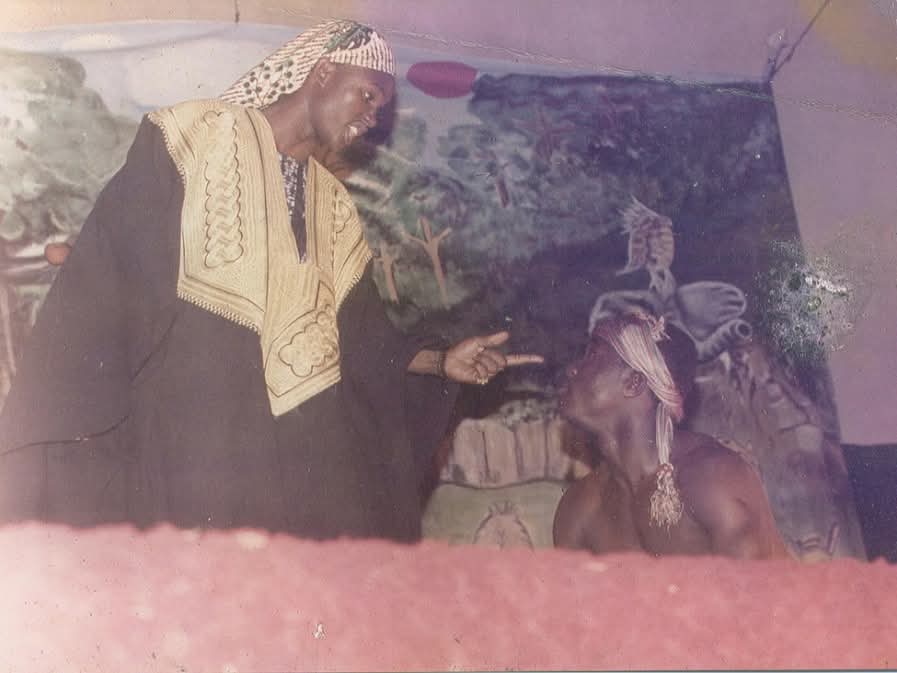
One of Dr. Gbaba profound memories from working as Principal of Zwedru Multilateral High School (ZMHS) in Grand Gedeh County was the formation of the ZMHS Cultural Troupe and the production of “Yah” (“Vision”). My vision in 1988 was to raise funds and to elevate the institution from a technical/vocational high school to a technical and vocational college.
In addition, his aim was to provide a wholistic and culturally relevant education for children in the hinterland of Liberia so that they may appreciate their cultural heritage and be on par with their colleagues around the country. Another reason was to showcase the talents of Liberian youth from the hinterland and promote the Grand Gedeh educational system nationally and internationally.
The ZMHS Cultural Troupe included prominent traditional Krahn artists and musicians the likes of Bai-Beh, Gayeah-Ninneh Gaye, Gayeebah-Paboo, and two prominent Krahn dance masks–“Zahjay Gleh” from Tchien Zonnie and “Voorpen” from Gorhbo-Francee. Altogether, the ZMHS Cultural Troupe consisted of one hundred performers of students and traditional artists combined.
About the Play
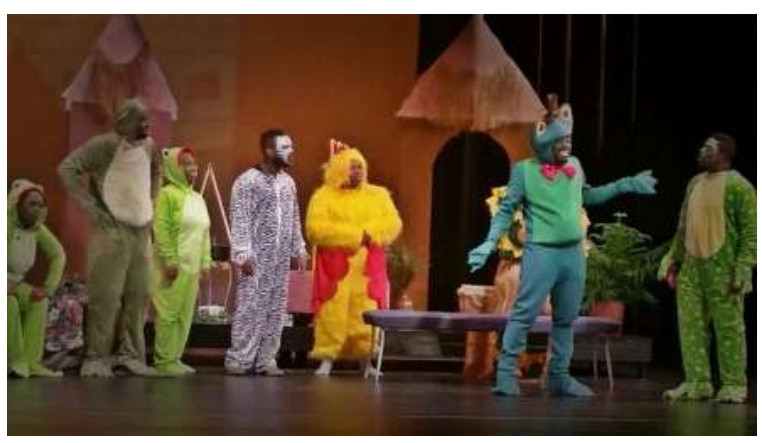
The word “Yah” in the Krahn language means, “vision”. It was a play he wrote, directed and produced to share a vision he had in which the status quo collapsed because they did not abide by the precepts of our ancestors.
The ZMHS Cultural Troupe travelled to Monrovia and stationed at the Chief Compound on Macdonald Street and Camp Johnson Road for two weeks. The play was performed at the Relda Theatre in Monrovia for two nights before a packed audience in 1988. Every evening, Liberians, especially members of the Krahn ethnic group of Liberia, gathered at the Chief Compound to be entertained by the traditional musicians and the dance masks.
Prominent Grand Gedeheans who supported this effort included T. Shad Garlo, General Alfred Manyeah, and Governor of the National Bank of Liberia, Thomas Voor Hanson, and Representative William Glay. President Samuel Kanyon Doe and many prominent Grand Gedeheans in government did not attend any of the performances.
Rabbi Prince Joseph Tomoonh-Garlodeyh Gbaba, Sr., Ed. D. August 10, 2026
MONROVIA, LIBERIA — August 17, 2026: Liberian cultural icon, playwright, educator and peace advocate Dr. Rabbi Prince Joseph Tomoonh-Garlodeyh Gbaba, Sr. has expressed appreciation to young Liberians and youth organizations for publicly supporting President Joseph Nyuma Boakai, Sr. for honoring him with Liberia’s Distinction in the Order of the Star of Africa with the Grade of Commander.
In a message directed to the youth, Dr. Gbaba thanked what he described as Liberia’s “progressive youths” for recognizing his more than 52 years of work aimed at preserving Liberia’s shared cultural heritage, promoting national unity and connecting younger generations with the traditions and values of their ancestors. He said his lifelong mission has been to ensure that Liberian youth understand and appreciate their ancestry, history and cultural traditions as essential foundations for building a peaceful and prosperous nation.
A Call for Youth Opportunities and Cultural Inclusion
Dr. Gbaba also raised concerns about what he described as barriers preventing qualified Liberians and youth leaders from contributing to national development. He said he has made efforts over the years to create opportunities for young Liberians through his areas of expertise, particularly culture, education, theatre and peace-building, but believes some proposals have not received the necessary attention from policymakers.
According to him, one of his major concerns is a strategic proposal submitted through Dehkontee Artists Theatre, Inc. (DATI) that seeks to create employment and training opportunities for Liberian youth while contributing to Liberia’s post-war peace-building and reconciliation process.He expressed hope that President Boakai will give favorable consideration to the proposal and provide an opportunity for its implementation.
Liberian Solutions to Liberian Challenges
Dr. Gbaba also called for greater participation of Liberian cultural and peace-building experts in national efforts to address the country’s social and cultural challenges. He specifically expressed concern over reported plans to establish a national cultural committee and the possibility of seeking lessons from countries such as South Africa and Rwanda without sufficient consultation with Liberian experts.
While acknowledging the value of international experience, Dr. Gbaba argued that Liberia’s challenges must also be addressed through its own history, languages, traditions and indigenous conflict-resolution practices. He emphasized that Liberia’s diverse ethnic communities have their own cultural systems and traditions that should be considered when developing national peace-building and reconciliation strategies.
“The resolution of a Rwandan conflict is not identical to the resolution of a Liberian conflict,” Dr. Gbaba maintained, stressing the importance of culturally relevant approaches to peace-building. He further argued that language and cultural understanding are essential when mediating conflicts involving Liberia’s various ethnic communities.
A Message to Liberia’s Youth
Dr. Gbaba urged young Liberians to remain committed to peace, national unity, cultural pride, justice and national development.He expressed appreciation to youth representatives from Maryland, Grand Kru, Margibi and River Gee Counties, as well as members of DATI chapters in Montserrado, Maryland, River Gee and Margibi, for standing with his vision.
He said their support demonstrates that Liberia’s young people remain interested in building a better future and preserving the country’s cultural identity concluded by expressing hope that President Boakai will support initiatives designed to provide jobs, skills training and development opportunities for Liberian youth, while strengthening national peace-building and reconciliation.
“My beloved children, thank you for standing with me and for recognizing the importance of the work we have undertaken for more than five decades. I pray that President Boakai will favor our proposal to create jobs and training opportunities for Liberian youths.”
Dr. Rabbi Prince Joseph Tomoonh-Garlodeyh Gbaba, Sr., Ed.D.
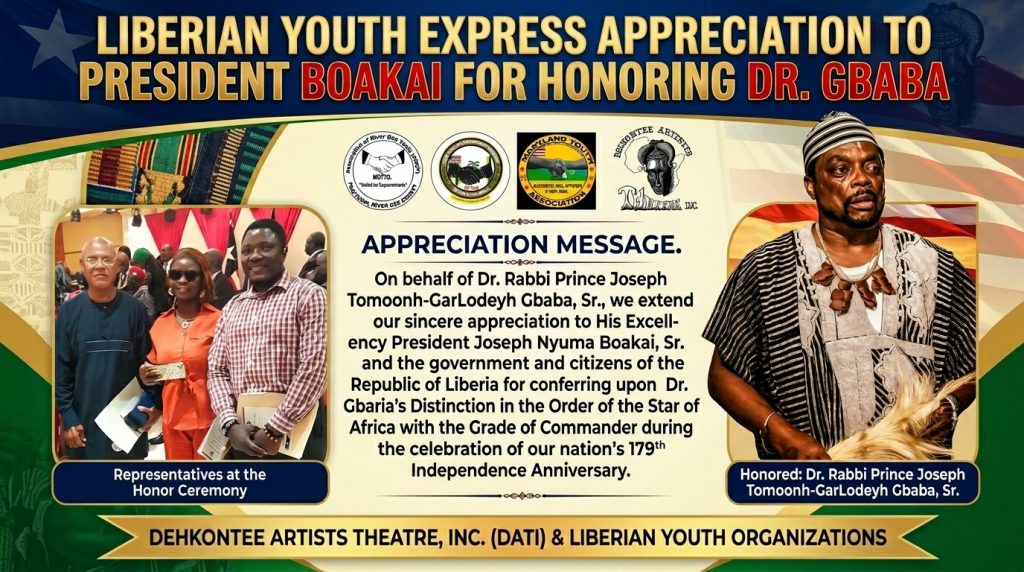
Representatives; left to right ( Statesman Meshach Sieh Elliott, Stateswoman Hawa Gowah and Mr. Rameses A. Porte, Jr)
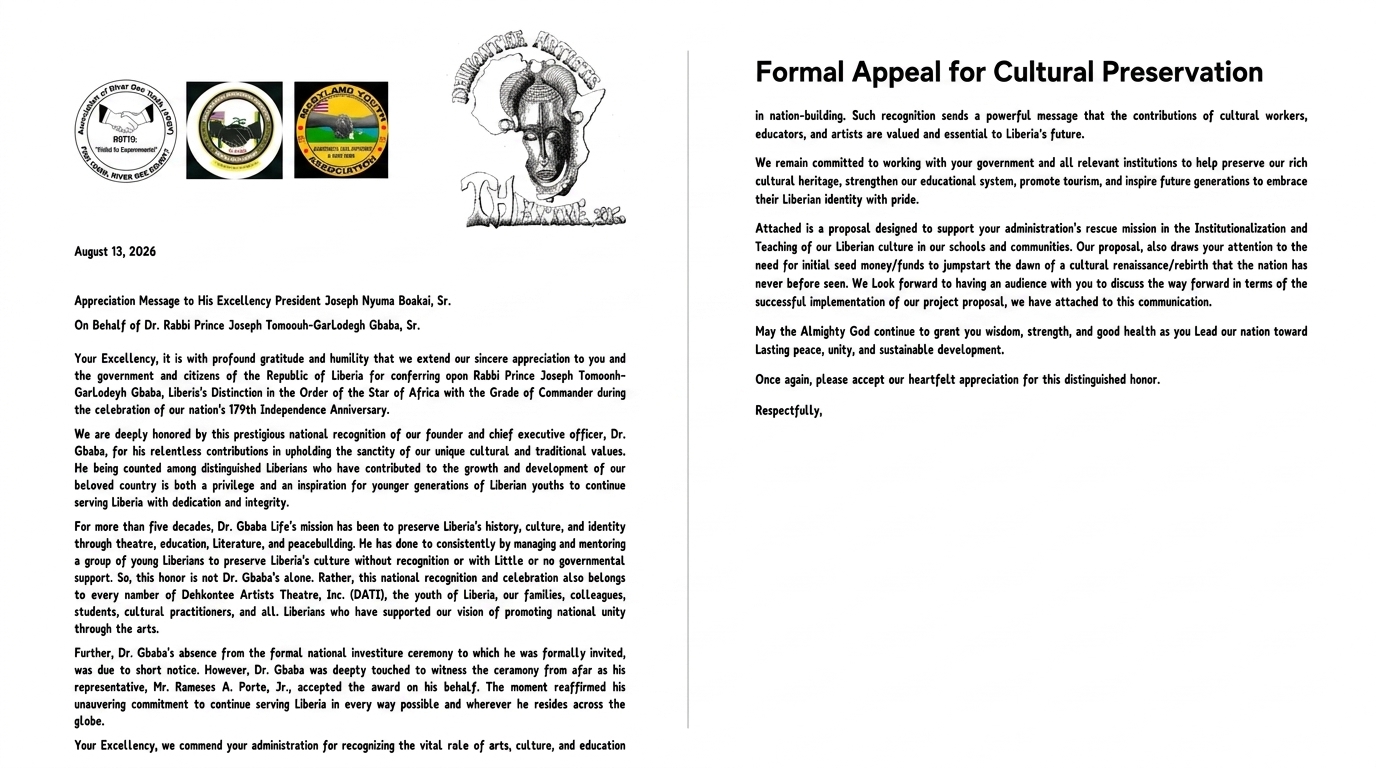
MONROVIA, LIBERIA — August 15, 2026: Youth organizations and young people from across Liberia have expressed appreciation to President Joseph Nyuma Boakai, Sr., and the Government of Liberia for conferring Liberia’s Distinction in the Order of the Star of Africa with the Grade of Commander on renowned cultural icon, educator, playwright and peace advocate Dr. Rabbi Prince Joseph Tomoonh-Garlodeyh Gbaba, Sr.
In a letter of appreciation, the youth described the recognition as a well-deserved honor for Dr. Gbaba’s more than five decades of service to Liberia through theatre, education, cultural preservation, peace-building and the promotion of national unity. The youth groups said the recognition should inspire a new generation of Liberians to embrace their culture, develop their talents and contribute meaningfully to national development.
They also welcomed Dr. Gbaba and Dehkontee Artists Theatre, Inc. (DATI)’s continued interest in working with the Government of Liberia on initiatives focused on national unity, cultural preservation, education, tourism and youth development. The letter concluded with a call for greater collaboration among the Government of Liberia, youth organizations and cultural institutions to preserve Liberia’s identity and build a more united nation.
Appreciation Letter
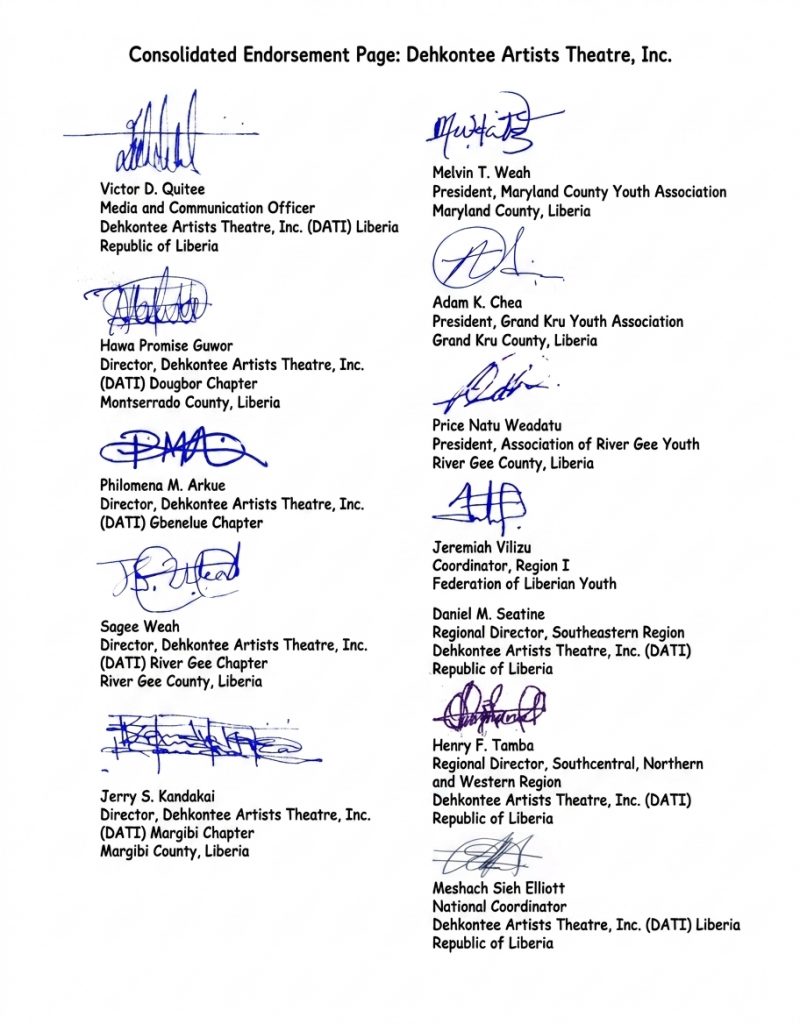
The appreciation letter was signed by representatives of DATI, youth organizations and regional leadership, including Victor D. Quitee, Media and Communication Officer, DATI Liberia; Hawa Promise Guwor, Director, DATI Dougbor Chapter; Philomena M. Arkue, Director, DATI Gbenelue Chapter; Sagee Weah, Director, DATI River Gee Chapter; Jerry S. Kandakai, Director, DATI Margibi Chapter.
Others are: Melvin T. Weah, President, Maryland County Youth Association; Adam K. Chea, President, Grand Kru Youth Association; Price Natu Weadatu, President, Association of River Gee Youth; Jeremiah Vilizu, Coordinator, Region 1, Federation of Liberian Youth; Daniel M. Seatine, Regional Director, Southeastern Region, DATI; Henry F. Tamba, Regional Director, Southcentral, Northern and Western Region, DATI; and Meshach Sieh Elliott, National Coordinator, DATI Liberia.
Youth leaders and DATI members signatures
For his part, Dr. Rabbi Prince Joseph Tomoonh-Garlodeyh Gbaba expressed heartfelt appreciation to progressive youth organizations across Liberia, particularly young people from Maryland, Grand Kru, Margibi, River Gee and Liberia at large as well as various DATI chapters, for what he described as their foresight, courage and commitment to progress and justice and publicly supporting and acknowledging President Boakai for conferring the national honor upon him.
The Rabbi Dr. Joe Gbaba
He said the advocacy of Liberia’s youth helped draw attention to his 52 years of service dedicated to preserving Liberia’s history, culture and shared heritage while promoting peace, national unity and youth development. The Rabbi Gbaba encouraged young Liberians to remain connected to their ancestral heritage and cultural traditions, emphasizing that a strong understanding of Liberia’s identity is essential to building a peaceful and prosperous nation.
He further expressed concern about barriers that prevent meaningful youth-development initiatives from reaching policymakers, particularly proposals designed to create jobs, skills training and peace-building opportunities for Liberian youth thus expressing hope that President Boakai will consider DATI’s proposal to create employment and training opportunities for young Liberians while strengthening the country’s peace-building and reconciliation efforts.
Meanwhile, the youth organizations emphasized that honoring Dr. Gbaba is not only a recognition of his past service, but also a call to invest in Liberia’s young people, culture and future outlining that the recognition should serve as an opportunity for Liberia to place greater emphasis on its cultural heritage, empower young people and build stronger partnerships between government, youth and cultural institutions.
Through it all God has been my strength, my very present help in times of peace and troubles and he made it possible for me to live to see this day when the LAMCO Family Reunion organization is giving me my flowers while I still have breath. It is also a plus to the Boikai administration for the national recognition as well and thanks to the youth of Liberia who have so much trust and faith in me as their father and mentor.
Today, our gathering is about a community that resided in Nimba County and we cannot celebrate LAMCO without celebrating the county and people in whose land we lived, attended school and worked. As for me and my household, we have a unique Nimba story and inheritance that I would like to share with you.
My Nimba Connections and Heritage
My connection with Nimba County is deeply rooted in traditional Liberian history. The people of Nimba and Grand Gedeh Counties have been neighbors and in-laws for centuries, long before the modern Republic of Liberia was established. Through interethnic marriages, we have children born through the unions of Krahn, Mahn, and Dahn parents, such as the Tuazamas, Towehs, etc. And, for the record, my Nimba relatives and friends call me “Saye Tomah Gbaba.”
Here, my name is blended with Mahn, Dahn, and Krahn backgrounds. I am named Saye because I am first born male in my family (even though technically speaking it is a name given to the first born of a woman, not the man). The name “Tomah” I inherited from my father. It was bestowed upon my father at birth more than a century ago by a Dahn chief who was friends with my grandfather named Keh-Gbaba, a descendant of the Nien Dynasty of Krahn kings and descendant of Yarlee-Gbenh, founder of Zwedru City, the capital city of the Krahn ethnic group of Liberia.
According to family history, when my father was born over a century ago, the Dahn chief who lived in Tappita traveled on foot with his entourage for miles, bringing gifts to congratulate my grandfather and to attend the naming ceremony. When the Dahn chief arrived and was warmly welcomed, he told my grandfather, “I name our son Tomah. In our dialect, “Tomah” means “a successor”. When I die, he will take my place.” That’s how my father got his Gio/Dahn name. Over the years, the Krahn people could not pronounce “Tomah” as it is pronounced in the Dahn language. Thus, they ended up mispronouncing Tomah as “Tomoonh”.
Beware of the Falsehoods of Liberian Politicians and Their Divide and Rule Tactics
I know for you young Liberians, you might be wondering, how come a Dahn chief named a Krahn prince with a Dahn name. If the people of Nimba and Grand Gededh are supposed to be “enemies” then how come a Dahn chief traveled hundreds of miles by foot to celebrate the birth of a Krahn prince? If the people of Nimba and Grand Gedeh are archenemies as the Liberian press and politicians portray then why are so many Dahn and Mahn people residing in Grand Gedeh and intermarried even after a so-called bloody civil war that claimed the lives of a quarter million Liberians?
I am sharing this story with you because the story you have been told about the people of Grand Gedeh and Nimba being “enemies” is FALSE. It is a distortion of the truth and it is a “divide and rule” tactic that the True Whig Party government used for more than a century to divide and rule Liberians by putting one ethnic group against the other to maintain power for more than 133 years.
My Childhood Experience as a Resident of Nimba County
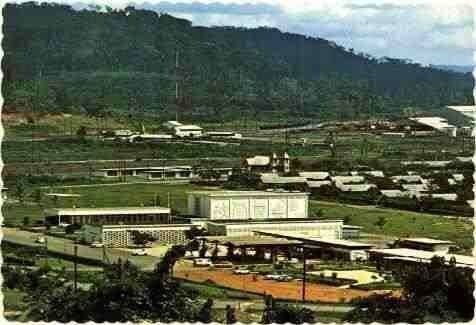
I was five years old when my parents relocated to Gbapa, Nimba County during the diamond rush in the late 50s and early 1960s. Gbapa back in the day was a small diamond mining settlement along the way to Yekepa, Cassava Farm and Camp Four and New Yekepa where I staged my first drama, “Life Story of Kekula” 52 years ago.
My parents were engaged in the diamond mining business. My stepfather (Thomas Sackor) worked at a diamond creek in Gbapa and my mother, Princess Gbeh-Nyennonh-Garh Gaye, ran her “cold bowl” shop.
There were no public schools in Gbapa those days, so my parents sent me to live with a Mandingo friend of theirs and a diamond broker named Lassana Kamara who lived in Sanniquillie to attend St. Mary’s Catholic Mission School. That was how I was privileged to see Presidents William V. S. Tubman, Osage Fu Kwame Nkrumah, and Papa Sekou Toure, when they attended the Sanniquillie Conference in 1959!
My Mandingo adopted father (Lassana Kamara) was married to a Mandingo lady named Ma Fanta and another Fula lady whose name I do not recall. He lived right up the hill opposite the Sanniquillie Market before you descend the hill where the Dunbar Pond is and before you go past St. Mary’s campus. My father Lassana Kamara did not have any child at that time so he took me with him everywhere he went to transact his diamond business. We traveled to Bahn and Seclepea and other regions of Nimba that I cannot recall. I even learned how to speak Mandingo at one point in time and I enjoyed the morning breakfast called “monnee”. It is a kind of cereal meal—very nice!
After several years in Gbapa, my parents moved back to Monrovia when I turned nine. The second time around when I returned to Nimba, I was enrolled at Archbishop Carroll High School as a sophomore student in 1972. For three years, I studied under the rigid and disciplinary guidance of English and Irish Christian Brothers, studied Shakespeare, Wordsworth, Rousseau, Emerson, you name it. Suddenly, in my senior year something happened that changed my life forever. I had a vision in which the Lord inspired me to write the “Life Story of Kekula” which today turned out to be a story about myself. What an irony.
“Life Story of Kekula” Starring Bill Ross, III and Rosaline Rogers
As you are aware, Archbishop Carroll High School those days was an all-boys school and so you might wonder how I recruited girls to participate and where did the rehearsals take place. As a young man, I carried myself responsibly. I founded a Christian organization on campus called Creating Friendship in Christ (CFC). I was the Right Hand Brother and Robert Freeman, Jr. was Left Hand Brother and Bill Ross, Henrique Zobon Scott, Harrison Yaidoo, Harry Tucker were Honorable Brothers.
We approached the parents and assured them that their daughters would be safe when they came on Carroll High Campus in Grassfield and I made sure those hot Carroll High Cobras did not mess around my girls. Mr. Sirleaf, a famous, loving, kind bus driver brought the girls on campus for rehearsals and took them back home safely.
On the day when we performed “Life Story of Kekula” in October 1974, the Open Door Theatre was full to capacity! Among some of the prominent LAMCO personalities who attended the debut performance of “Libe Story of Kekula were Honorable Charles B. Roberts, Administrative Manager, Honorable John G. Rancy, Superintendent of Schools, Dr. Varsay Sirleaf, Magistrate James Harris, Sr., and my surrogate mother, Mrs. Dolly McCritty Massaquoi.
Members of the cast included Robert Freeman, Jr., Caleb Domah, Henrique Scott, Winston Conteh, Joseph Zig Collins, Jr., Stephen Daniels, Jr., the Cole Sisters, Roseline Rogers, Geleh Massaquoi, Bill Ross, III, Kerper Dwanyen, Leon Padmore, Patrick Forforh, Edsel Deshields, Joseph E. Deshields, Charles Samuels, Africanus Richardson, Patrick Ajavon, Harrison Yaidoo, Harry Nagbe Tucker, Jarloth Wolo, Jr., Allen Cassell, Samuel Brownell, Jr., etc. There were members of the international community in the house as well.
Interestingly, the elders who watched the show could not believe what they saw. Honorable Charles B. Roberts laughed his heart out in the balcony and when the show was over, he came down to congratulate me. He gave me my first pay check as a playwright, Five Hundred Untied States Dollars! Mommy Dolly wrote me a note congratulating me and foreseeing my becoming “Liberia’s Shakespeare”, and Magistrate Harris, blessed me and urged me to “keep up the good work.”
“Life Story of Kekula” was a documentary about national integration and unity, but it was a comedy and through the comic scenes I presented a narrative about creating national unity through interethnic marriage.
Today, I am a living witness to what I preached 52 years ago. Princess Ariminta, my wife, is a member of the Porte Family from Crozierville and I am a descendant of Krahn kings from Grand Gedeh County. My wife is the new “Sussie” and I am new “Kekula” and our intermarriage is blessed with five children and fifteen grandchildren, some of whom are present today.
Our children and all Liberians born of interethnic marriages and their offspring constitute what I would term the “core lineage” of the new Liberian society. 52 years ago, our society was segregated on tribal lines or class system but today we are a more blended and integrated society.
A Big ‘Thank You’ to My Nimba Parents, Guardians and Friends
My success in Nimba County was not attributed to only my schoolmates, professors, and my parents. There were many families that opened the doors of their homes to me as a student whose parents were from Grand Gedeh. My Mandingo father Lassana Kamara, Ma Fanta, Mommy Dolly McCritty Massaquoi, my other parents included Mr. and Mrs. Stephen Daniels, Sr., Mr. and Mrs. Joseph Zig Collins, Sr., Mr. and Mrs. Cassell, Mr. and Mrs. David Dwanyen, Mr. and Mrs. Gabriel Farngalo, my friends Deborah Cranshaw, Ophelia Dolo, Margaret Dookie, and my brothers James Zota (aka Dennis), Patrick Suah, Patrick Forforh, Caleb Domah, George Farngalo, George Dahn, Nathaniel Biah, George Jacobs, Prince Tebbs, and LAMCO Family Union Organization.
What a blessing to be in your midst!
I love you.
Rabbi Prince “Saye Tomah” Gbaba, Sr., Ed. D. August 8, 2026
By: Victor D. Quitee ( DATI Media and Communication Officer)
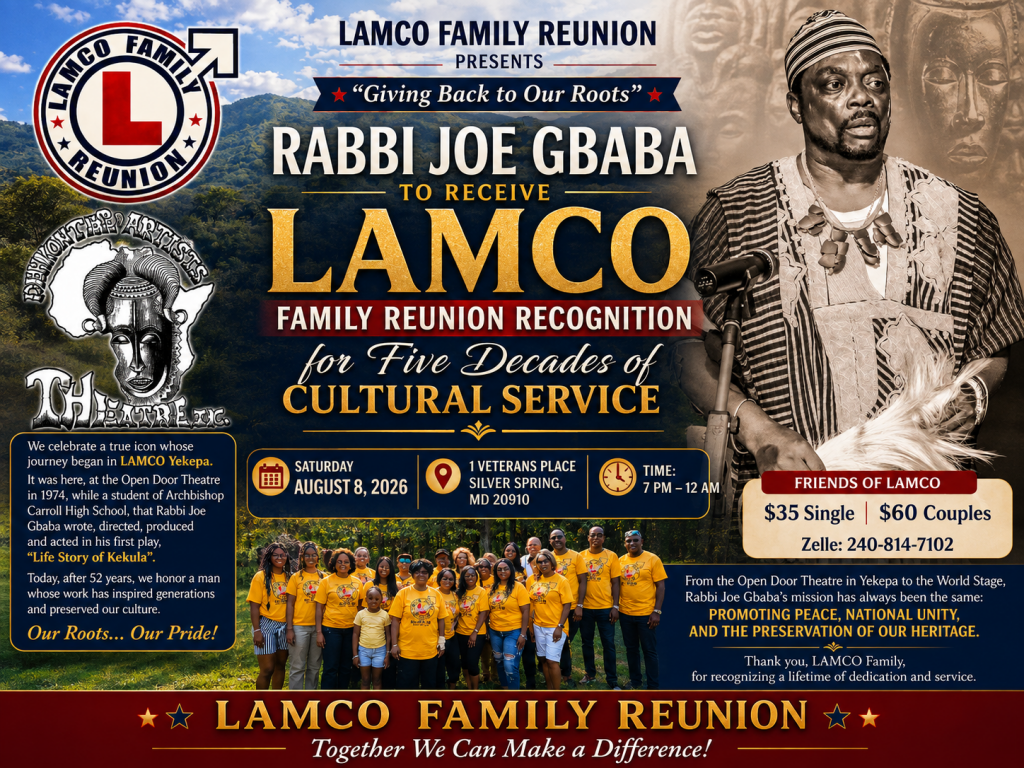
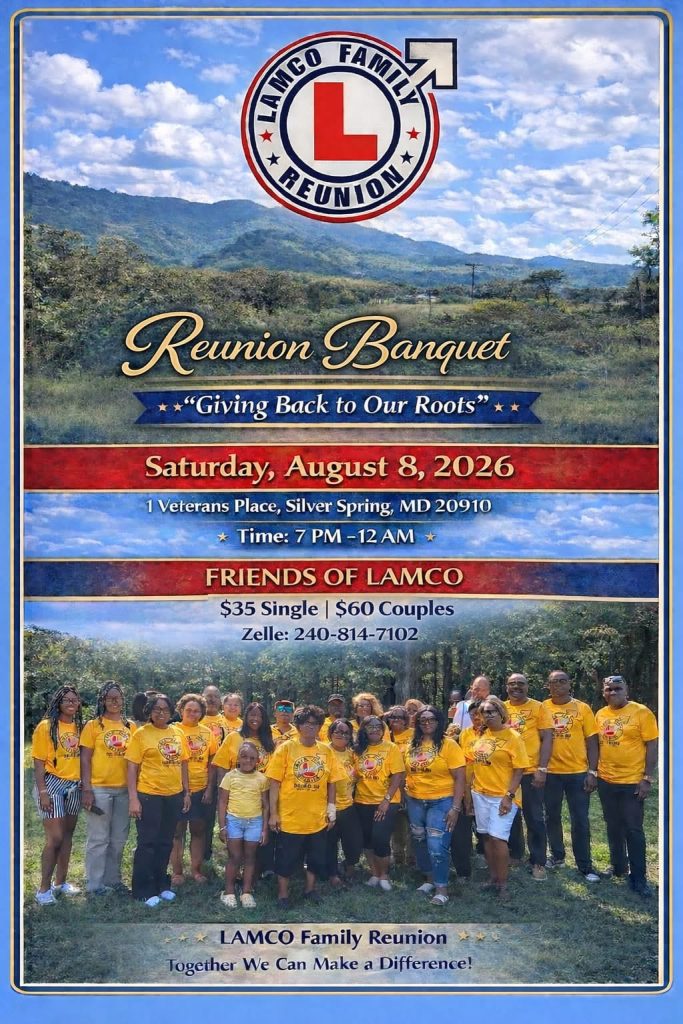
LIBERIA – Just weeks after being conferred with Liberia’s Distinction in the Order of the Star of Africa with the Grade of Commander by His Excellency President Joseph Nyuma Boakai, Sr., renowned Liberian playwright, theatre director, educator, and cultural icon Dr. Rabbi Prince Joseph Tomoonh-Garlodeyh Gbaba, Sr. is set to receive yet another prestigious recognition—this time from the former residents of LAMCO Yekepa during the LAMCO Family Reunion on Saturday 8th, August 2026.
The recognition celebrates Dr. Gbaba’s outstanding contributions to Liberia’s cultural heritage and pays tribute to the community where his remarkable journey in theatre first began more than five decades ago.
The recognition and honoring ceremony is being hosted by former residents of LAMCO Yekepa, the community where Dr. Gbaba’s theatre career began. It was in Yekepa, while attending Archbishop Carroll High School, that he wrote, directed, produced, and acted in his first stage play, Life Story of Kekula, which premiered at the Open Door Theatre in 1974. The honor is especially meaningful because it comes from members of his very first audience—individuals who witnessed and encouraged the beginning of a journey that has now spanned 52 years of dedicated service to Liberia through theatre, education, cultural preservation, and peacebuilding.
The LAMCO Family Reunion recognition comes on the heels of another historic milestone. During Liberia’s 179th Independence Day celebrations, His Excellency President Joseph Nyuma Boakai, Sr. conferred upon Dr. Gbaba Liberia’s Distinction in the Order of the Star of Africa with the Grade of Commander, one of the Republic’s highest national honors, in recognition of his exceptional contributions to the preservation of Liberian culture, education, literature, and national development.
Together, the two honors represent both national recognition and community appreciation—one bestowed by the Republic of Liberia and the other by the very people who first witnessed and encouraged the birth of his life’s calling.
Describing the significance of the moment, Dr. Gbaba said the recognition extends beyond a personal achievement. “This occasion signals a national reawakening. It is a symbol of my calling to unite all Liberians across every spectrum of our national life through arts, culture, education, and peace-building. This honor belongs to every Liberian who believes in national unity, reconciliation, and the preservation of our cultural heritage.”
Dr. Gbaba also extends heartfelt appreciation to the LAMCO Family Reunion Organization and the former residents of LAMCO Yekepa for recognizing his lifelong service. “I sincerely thank the LAMCO Family Reunion Organization and the former residents of LAMCO Yekepa for this distinguished honor. It means a great deal to my mission of promoting peace, national unity, and preserving Liberia’s cultural heritage. To be recognized by those who first believed in my work more than five decades ago is both humbling and inspiring” also reaffirming his willingness to collaborate with the Government of Liberia in advancing national initiatives focused on rebuilding the country’s cultural foundation.
According to him, his priority moving forward will be to support efforts aimed at:
1. Promoting National Unity by using theatre, education, and the performing arts to bridge ethnic, political, religious, and social divides.
2. Revamping Liberia’s Cultural Activities by preserving and promoting both Indigenous and Settlers’ traditions, including Liberian languages, history, music, dance, literature, customs, and cultural heritage, while advancing the establishment of Liberia’s first School of Performing and Visual Arts through Dehkontee Artists Theatre, Inc. (DATI).
As part of the Golden Jubilee celebration, DATI has launched a fundraising campaign to construct Liberia’s first School of Performing and Visual Arts, an institution envisioned to preserve and institutionalize Liberian culture while training future generations of artists, educators, researchers, and cultural ambassadors.
The LAMCO Family Reunion honor is expected to bring together former residents of Yekepa, classmates, friends, and admirers to celebrate the legacy of a man whose life’s work has inspired generations and whose vision continues to shape Liberia’s cultural identity.